SUBDURAL HEMATOMA

Subdural Hematoma Treatment

Expert management of subdural bleeding — from chronic monitoring to emergency evacuation.

Understanding

Understanding Subdural Hematomas

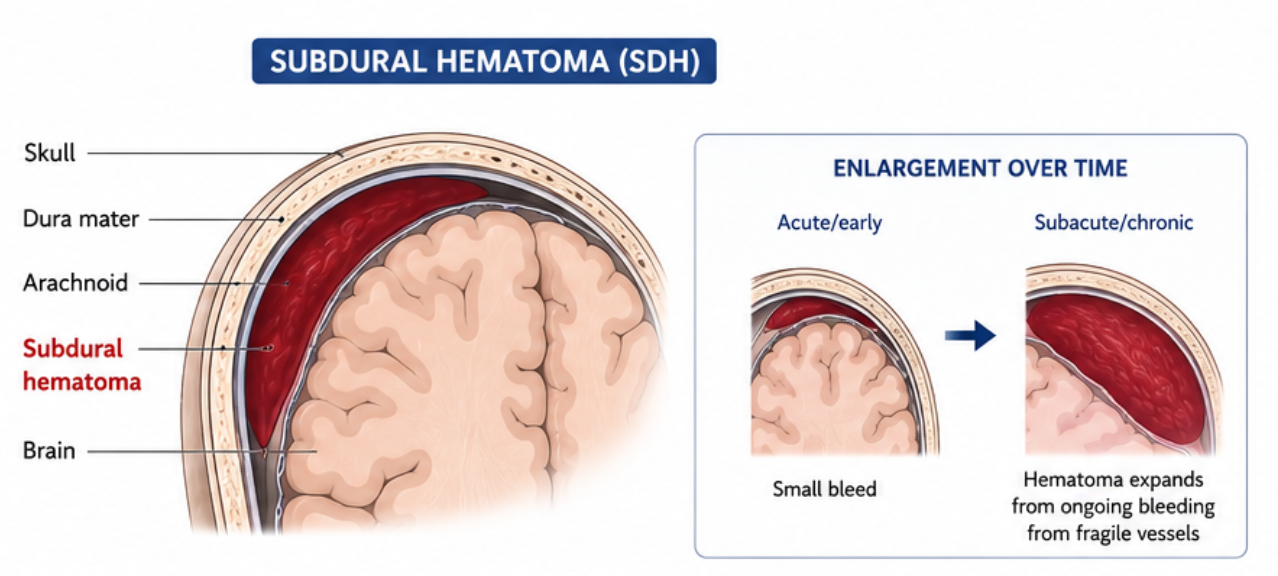
A subdural hematoma is a collection of blood that forms between the brain and the dura mater — the tough outer membrane that covers the brain. Chronic subdural hematomas develop slowly over days to weeks, often after a minor head injury or even without any remembered trauma, and are particularly common in older adults.

Symptoms can include headaches, confusion, weakness on one side of the body, difficulty walking, and changes in personality or alertness. Because these symptoms may develop gradually and mimic other conditions, subdural hematomas can sometimes go undiagnosed without proper imaging.

Understanding subdural hematomas
Symptoms

When to Seek Care

Acute Subdural Hematoma — Emergency

An acute subdural hematoma develops rapidly after a significant head injury and is a medical emergency. Seek emergency care immediately for:

Sudden confusion or loss of consciousness
Severe headache that worsens rapidly
Vomiting
Weakness or numbness on one side of the body
Seizures
Unequal pupil size
Slurred speech

Chronic Subdural Hematoma — Needs Evaluation Within Days

Chronic subdural hematomas develop slowly and symptoms may be subtle. Contact your doctor promptly if you experience:

Gradually worsening headache
Confusion or difficulty concentrating
Personality changes in an older adult
Difficulty walking or frequent falls
Increasing drowsiness or lethargy
Mild weakness on one side
CT scan showing a subdural hematoma — emergency warning signs
Comparison

Traditional Treatment vs. Embolization

TS
Traditional Surgical Treatment

The standard treatment for subdural hematomas has been surgical drainage — either through a burr hole (small opening in the skull) or a larger craniotomy. While effective in many cases, surgery carries risks including infection, bleeding, and recurrence. Some patients, particularly elderly individuals or those with significant medical conditions, may not be ideal surgical candidates.

EM
Middle Meningeal Artery Embolization

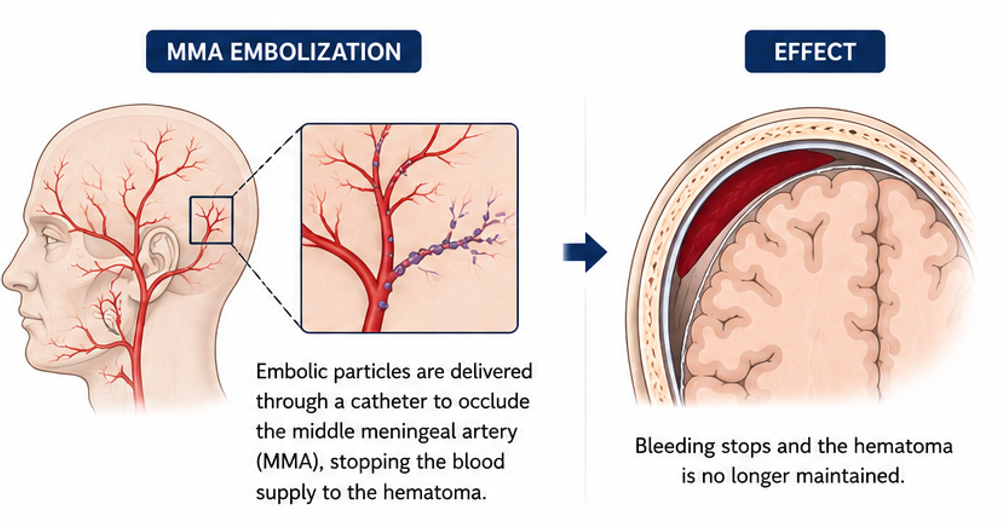
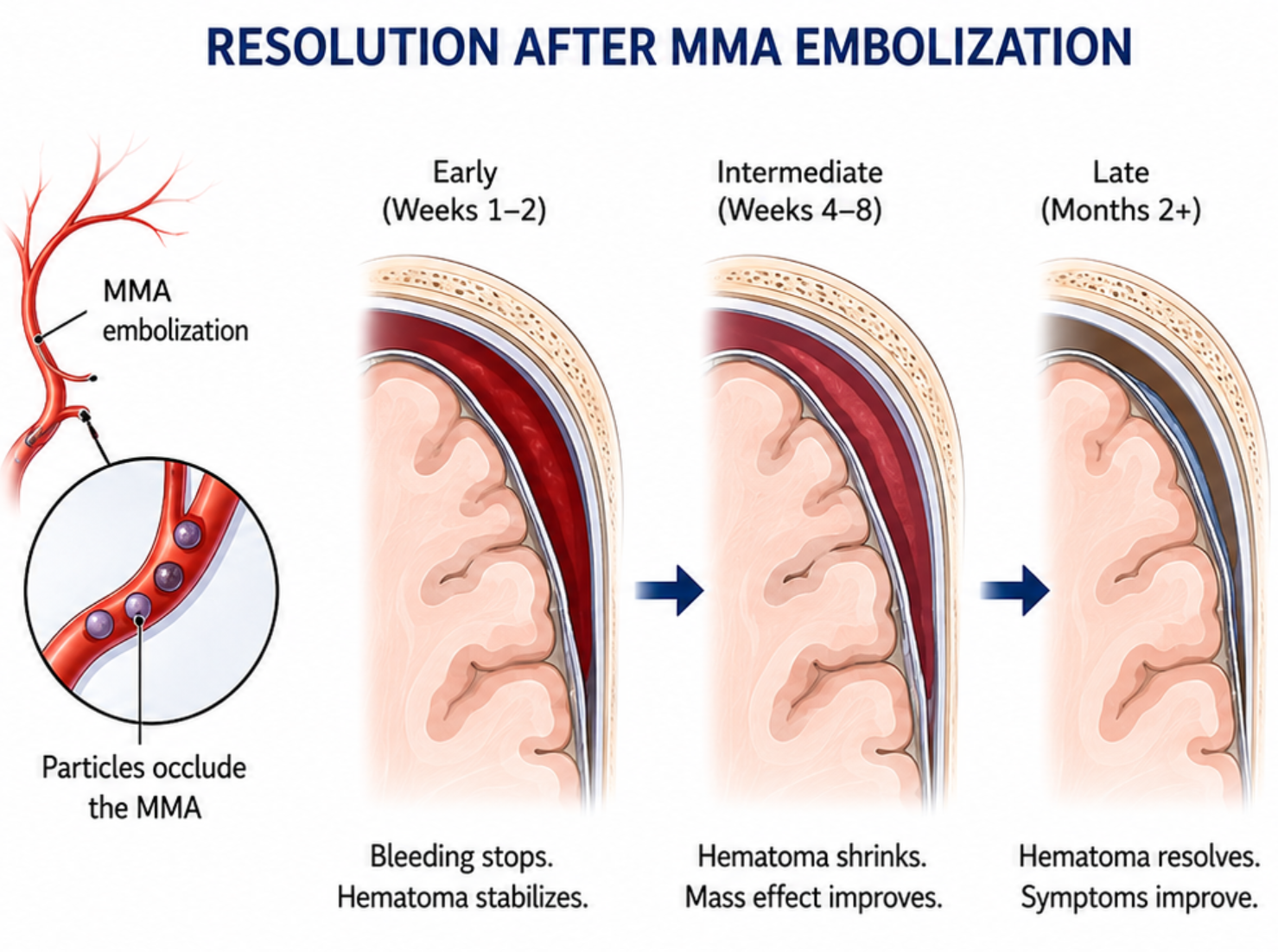
Embolization is a newer, minimally invasive option that seals the blood vessels supplying the outer membrane of the hematoma — specifically the middle meningeal artery. By blocking these vessels, the bleeding stops and the hematoma can resolve without open surgery. This approach is performed through a small catheter, requires no incision in the skull, and dramatically reduces recovery time and risk.

Subdural hematoma treatment comparison
Procedure

The Embolization Procedure

This minimally invasive procedure is performed in an angiography suite and typically takes less than an hour.

1
Catheter Access
A thin catheter is inserted through an artery in the wrist or groin and navigated to the middle meningeal artery using real-time X-ray guidance.
2
Angiographic Mapping
Contrast dye is injected to create a detailed map of the blood vessels feeding the hematoma membrane, identifying the precise targets for embolization.
3
Embolization
Tiny embolic particles or coils are deposited into the targeted blood vessels, blocking blood flow to the hematoma membrane and stopping the bleeding.
4
Confirmation & Recovery
Follow-up imaging confirms that the targeted vessels are sealed. The catheter is removed, and patients typically recover quickly with minimal discomfort.
The embolization procedure
Benefits

Benefits of Embolization

Minimally invasive — no open brain surgery or skull incision
Performed under moderate sedation rather than general anesthesia
Significantly shorter recovery time compared to surgery
Lower risk of infection and surgical complications
Can be used as standalone treatment or to reduce recurrence after surgical drainage
Excellent option for elderly patients or those with medical conditions that increase surgical risk
Benefits of embolization
Frequently Asked Questions

Subdural hematoma questions, answered

Related Conditions

Exploring your treatment options?

Our neurovascular specialists can evaluate whether embolization is right for you. Contact us for a consultation.